
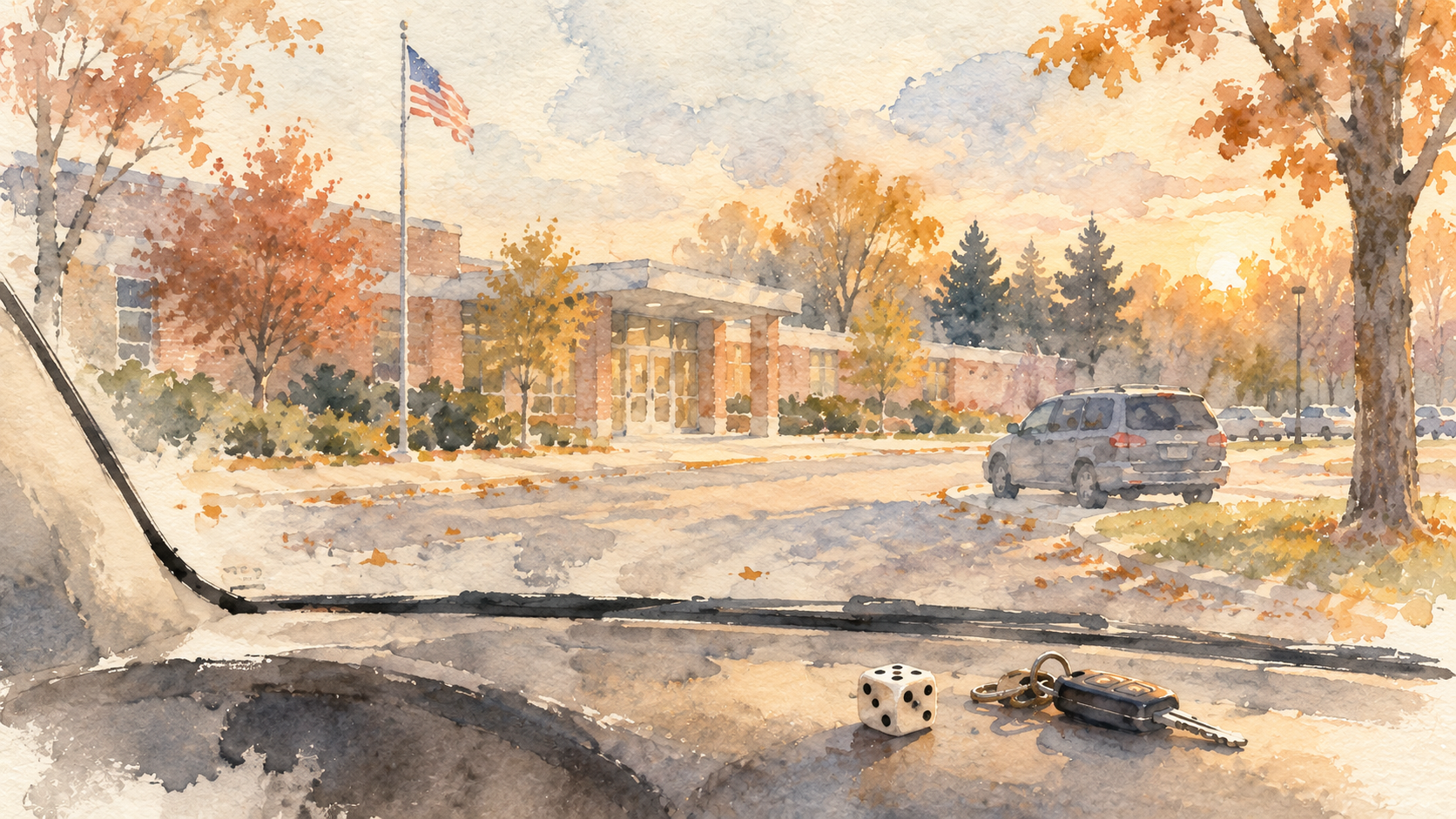
Since September I have picked up Micah and Ivy on 19 of 57 school days. My wife regards the other 38 as failures. On pickup days they now run to the car.
The school dismisses at 3:10. Happy hour at the Brass Rail starts at three, and Carla, who is recently divorced, works Tuesdays through Fridays. My work on Meta's Child Safety team—determining the optimal ratio of pro-ana to mukbang content shown to young users—can be done from a laptop. If I collect the children, take them home and wait for their mother, I arrive just as the drinks become expensive and every man who installs drywall for a living begins competing for Carla's attention. Going at three gives me the same beer for half the price and, on a good afternoon, most of a conversation. School pickup occupies an unusually valuable part of my day.
For two years I did it anyway. I rearranged meetings, sat in traffic and listened to a lengthy account of what somebody named Brayden had done with a glue stick. By last spring Ivy would see the car and keep talking to her friend. Micah sometimes got in without saying hello. They treated my presence as a fact about the street.
I tried being more fun. I brought snacks, let them choose the music and once arrived with the dog. The dog did well. Within a fortnight he, too, was expected. I was spending more to obtain a response I had received simply by existing when they were three.
At work we had faced something similar with a daily-reward feature. Give people the same thing every day and they claim it automatically. Make the reward uncertain and they begin thinking about it before they open the app. They come back to check. Some check repeatedly even when we have nothing for them.
I decided to apply the same principle to being their father.
Each morning I roll a die. On one or two, I collect them. On three through six, they stay in aftercare until their mother finishes work. I do not tell the children the result. The office asked for a schedule, so I sent them the probability distribution. Mrs. Dombrowski replied that she needed to know whether I was coming on Tuesday. I explained that knowing in advance would defeat the purpose.
There were improvements within days. Both children began running to the car. Ivy would hold my neck with both arms and ask whether we could go straight home together. Micah started telling me things while he was still fastening his seat belt. I had increased the value of an ordinary ride home without changing the car or the destination.
Their mother says they were relieved. I agree. Relief is an extremely powerful reward, and I had previously been supplying it at such regular intervals that neither child had occasion to experience it.
On the other afternoons I usually went to the Brass Rail. There is a video-poker machine at the end of the bar, and Carla sometimes lets me stay on it while she changes the keg. I have also used the time to dispute a charge for a lap dance, watch a man try to eat twelve hard-boiled eggs and explain to Carla why her ex is probably a narcissist. She has told me very little about him, but the available evidence supports continuing the conversation.
My wife calls these activities a poor substitute for being with the children. That comparison ignores timing. I can hear about Brayden at dinner. By dinner Carla has six tables, the machine is occupied and the wings cost eleven dollars. Other customers respond to the same incentives. If I voluntarily arrive late, none of them reciprocates by leaving me a stool.
Sometimes I collect the children even when the die says not to. Carla was off sick one Thursday, for example, and I went straight to school. I have excluded that day from the results because the intervention was driven by an external event.
I began testing small changes. At 2:50 I sometimes asked the office to tell them I might be coming. Once I drove slowly past the pickup line and waved without stopping. Ivy ran along the fence. Her teacher called that evening and asked why I had done it. I explained the near-miss effect: the user sees how close they came to receiving the reward and becomes more likely to try again. She said Ivy had cried for forty minutes. I asked whether she had stopped watching the road.
Micah, who is nine, started keeping records. Weather, day of the week, whether I had shaved, what color shirt I wore at breakfast. He asked if I came more often when he got all his spellings right. I told him I was proud of his spelling. That was true, and it would have been irresponsible to extinguish a useful behavior merely because he had an incomplete account of its causes.
Ivy's method was less systematic. She began putting things in my shoes so I would remember her. A drawing, a bracelet, once a damp leaf. My wife showed me the leaf as though it were evidence against the schedule. For two years that child had assumed I would be there without giving the matter a thought. Now she was making things for me before breakfast.
The aftercare bills exceeded what I saved on beer. I have never claimed that the program should be evaluated on beverage costs alone. My wife's pickups provided a useful comparison: she came when she said she would, and the children walked to her car at an ordinary pace. She said this was because they trusted her. I asked what observable behavior would distinguish trust from indifference. She told me to get out of the kitchen.
Mrs. Dombrowski eventually stopped passing along my messages. When I called to say "maybe today," she said, "Either come get your children or don't." I asked her to say exactly that to them. She hung up.
Then, three weeks ago, they stopped coming to the car.
Their mother had arranged for Mrs. Castellano to collect them with her own children. She arrives at 3:10 every day in a gray minivan. The children know which seat is theirs. There are cheese crackers. It is very similar to the approach I had already tested and abandoned.
The first afternoon I called Micah's name. He pointed to the minivan and said they were going with Mrs. Castellano. I told him I was here today. He said he knew. Ivy got in after him.
I assumed they would lose interest once the arrangement became familiar. In the meantime I needed to remain visible, so I began parking by the flagpole every afternoon. Most days they walk past. Sometimes Micah nods. Once Ivy came over, and I had already opened the door before she told me she needed her jacket from the back seat.
There have been encouraging moments. Last Thursday she stood at my window for almost a minute and told me about a caterpillar. On Friday neither child looked at me. Monday was the same. I thought Tuesday might be better because it was raining and they would have to pass closer to the car, but Mrs. Castellano had moved up to the covered entrance.
I have been there seventeen school days in a row now. I leave work at 2:40 because traffic can be unpredictable, and I bring the cheese crackers they like. Their mother says I can stop coming because the rides are covered. That would mean missing any afternoon on which they did decide to come over, and we would learn nothing from it.
Yesterday Ivy looked toward the flagpole before getting into the minivan. I have moved my three o'clock meeting for the rest of the month.
The behaviorist reading of the second half is pretty clear. What you ran was an intermittent schedule, and when reinforcement stops on one of those you usually see an extinction burst before the behavior fades. Ivy running along the fence after the drive-by was the burst. The minivan is what extinction looks like afterward.
I'm not prepared to call it extinction until the data are in. She looked toward the flagpole yesterday.
I've taught second grade for eleven years. The kids who sprint to the car at pickup are almost never the ones whose parents come every day. I used to think that was enthusiasm.
Micah logging the weather, the shaving and the shirt color is the most scientifically sound behavior in the post. It's exactly what subjects do on an unpredictable schedule they can't see. Skinner's pigeons built little rituals around whatever they happened to be doing when the food arrived. He's nine and he's doing the same thing with a spreadsheet.
I've considered telling him about the die. It would compromise the study.
We ran variable rewards on a daily-login feature at my last job. The part nobody writes up is the ending. Variable rewards retain users until a competitor offers the same thing reliably, and then they churn all at once. In your case the competitor is Mrs. Castellano.
19 of 57 is exactly one third, which is what a fair die gives you for one or two. So the die is fine.
I check it monthly.
Running to the car is consistent with relief from uncertainty. Your comparison treats a child calmly approaching a reliable parent as a worse outcome. I'd like a justification for that objective function.
The comparison uses observable engagement in place of competing verbal accounts. I agree calm behavior can be valuable, but it supplies less evidence about how much the ride is wanted.
Mrs. Castellano has supplied a schedule, seats and crackers. You're now supplying all three while waiting seventeen days for an uncertain interaction. Have you included your own behavior in the reward-schedule analysis?
How's it going at the flagpole?
Day 33. Ivy waved twice this week, Tuesday and Thursday. I'm logging both.
The drywall-installer argument explains why you prefer the bar at three. It doesn't explain why your children should carry the uncertainty that buys you that advantage.
carla if youre reading this, run