
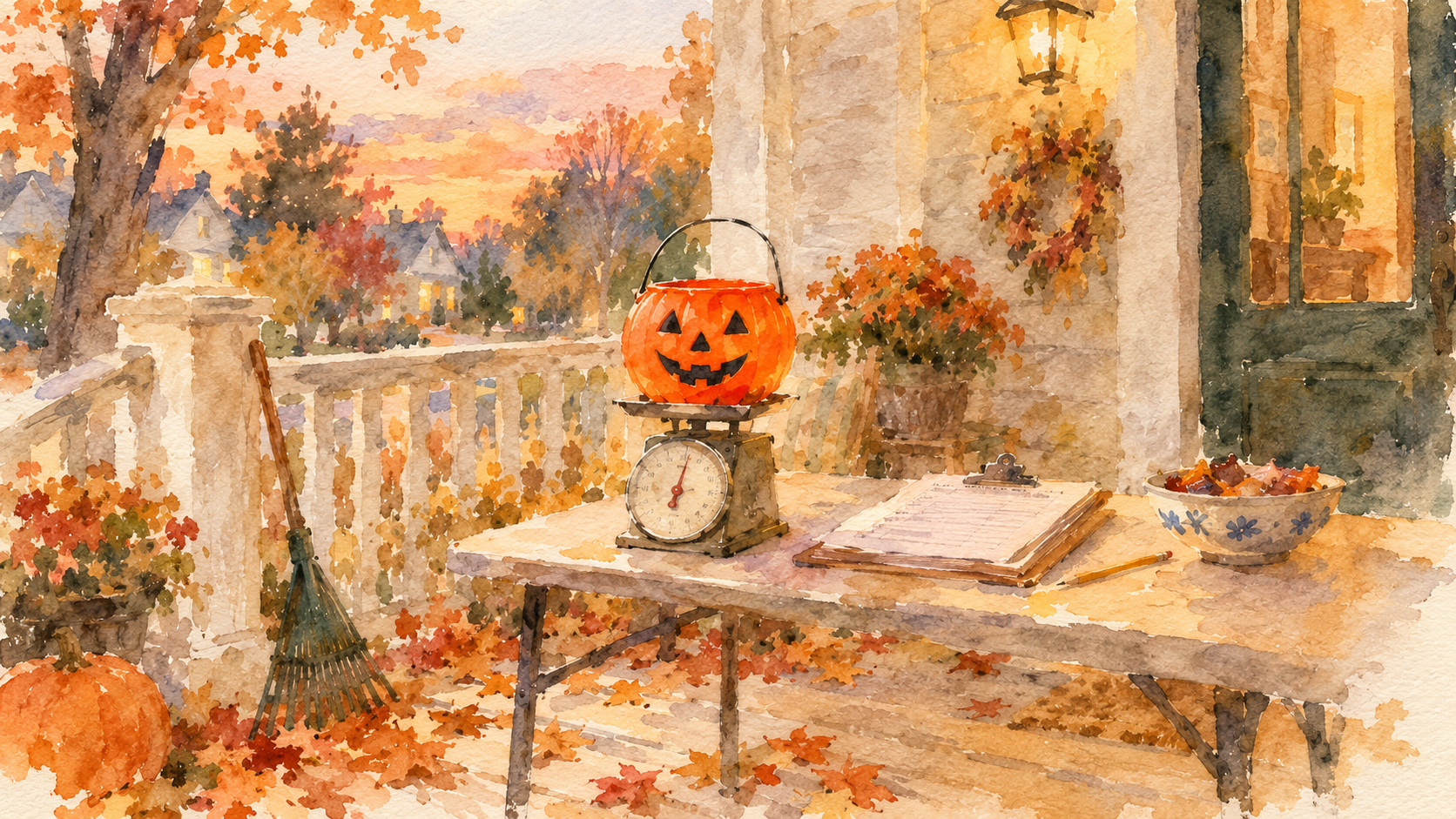
For nine years my household ran an open-enrollment candy program. Any child who reached the porch and recited a three-word demand received a benefit, no questions asked. Last October I gave out 412 pieces to 86 recipients and did not collect a single data point on any of them. I knew nothing about their need, their household candy income, or whether they had already been to the Okonkwos at number 22, who hand out full-size bars and have never audited anyone.
Unconditional candy creates dependency. A child who learns at six that goods arrive in exchange for a costume and a phrase will expect the same at sixteen, and I have had sixteen-year-olds at my door, in hoodies, holding pillowcases. So this year I rebuilt the program around three principles. Benefits should go to children who need them. Recipients should show effort. And every piece should be accounted for.
Program design
| Requirement | Documentation | Notes |
|---|---|---|
| Work | 20 hours of chores in the prior 30 days | Attested by a non-relative. Raking at an approved worksite counts double. |
| Income | Household Halloween income from all sources | Includes grandparents. Subject to audit. |
| Assets | Bag or bucket weighed at the door | Over one-third full: presumed ineligible. |
| Identity | Costume plus one other form of ID | Masks off for the photo. |
| Benefit | One fun-size bar | Subject to clawback. |
There is at present one approved worksite, which is my yard.
The asset test drew the most questions, so I will set out its logic. A child who arrives with a heavy bag has other resources and does not need mine. A child who arrives with an empty bag at eight o'clock has plainly not been trying. The eligible population lies between them, and I kept a kitchen scale on the folding table to find it.
Clawback applies when a recipient is later observed at a household offering more generous terms. My brother-in-law Craig, who is a notary, handled attestations from a lawn chair by the mailbox and watched number 22 with binoculars. I paid him $150 and a share of recoveries.
Results
Applications fell from 86 to 5, a 94 percent reduction in caseload.
Two of the five were denied for incomplete paperwork. One, a Spider-Man, was flagged as a possible duplicate of an earlier Spider-Man and referred for review. One, a bee of about four, could not produce a work history. Her mother said, "She's four." I explained that there is a hardship exemption, and that the exemption has a form.
The fifth applicant was approved. She was a nine-year-old skeleton with a binder, a chore log signed by her piano teacher, and a mother who stood at the end of the walk with her arms folded and turned out to be an attorney. She received one fun-size Milky Way. Craig recovered it at 8:40, when she was seen on the Okonkwos' porch.
Net benefits paid came to zero pieces, against 412 the year before. Administrative costs were $311, covering forms, lamination, the scale and Craig. Critics will note that this is more than I used to spend on candy, which misses what the money was for. Last year it bought dependency. This year it bought program integrity.
Objections
Several parents told me that the children "just say trick or treat," as though that settled the matter. "Trick or treat" is a demand backed by a threat. It has never been an application.
My wife points out that our own two came home with 4.2 pounds each from households that asked them for nothing. I agree that this is troubling, and I have written to those households.
It has also been put to me that applications fell because of the paperwork and not because need fell. But a child who truly needed a fun-size bar would have completed the form. The ones who walked past my table to number 22 were telling me how badly they wanted it.
Next year
My garage door was egged on the first of November, and Craig's car on the second. I have been told to take this as feedback. I take it as a description of the population I was serving, and as support for the reforms I have planned: a lifetime limit of five Halloweens, and a transition from candy to work, in which the bar is replaced by the opportunity to rake.
The block association has since voted to route next year's parade around my house. If that holds, my caseload will reach zero, which no program on this street has ever achieved.
Five of 86 is a 6% take-up rate, which is an ordeal mechanism working exactly as designed. The theory says ordeals screen for need when needy applicants have lower time costs than everyone else. Children's time costs on Halloween are roughly uniform, so what your forms actually screen on is parental time, and parental time tends to correlate with income in the wrong direction. You selected for the skeleton with the attorney.
Parental time is a legitimate thing to screen on. A child whose parent won't complete a one-page form is receiving candy decisions from an adult with other priorities, and I don't think my porch should be subsidizing that.
The paperwork has reduced your caseload, but the children appear to have kept their access to candy. Are you measuring dependence on your program or dependence on candy in general?
My responsibility is to administer my own porch. I have asked the other households to share eligibility records, but participation has so far been disappointing.
The attorney mother may have spent a lot more than $311 putting that binder together. Your administrative-cost figure leaves out the work you required recipients to do.
Parade went around your house this year as promised. How did the caseload look?
Zero. The program ran at full integrity and paid no benefits. Craig was on the lawn chair until 9 and saw nobody.
Number 22 is crowding you out. Full-size bars with no eligibility rules mean any child with a functioning cost-benefit sense routes around your porch. Your caseload fell partly because the Okonkwos exist.
I agree that number 22 is the larger problem. I've raised it with the block association, which has not yet responded except by moving the parade.
Craig gets $150 regardless of need plus a share of recoveries, which works out to a performance bonus for taking a Milky Way from a nine-year-old. Administrator compensation should be subject to the same means test as the benefit.
Craig's compensation is for services. Services aren't benefits.
Was the Spider-Man duplicate ever resolved?
Still under review. Both Spider-Men were the same height and neither would remove the mask for the photo, which is itself a documentation issue.