
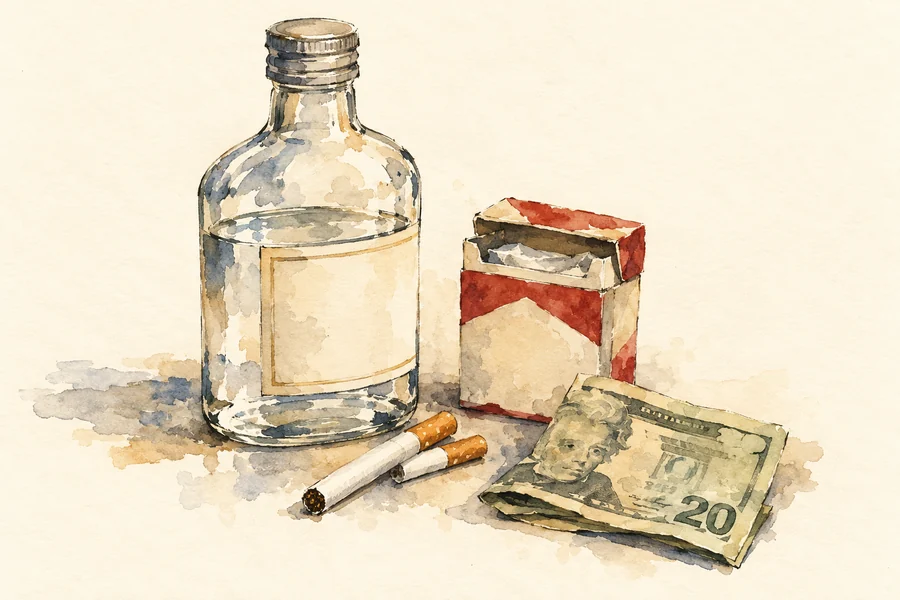
Venmo me $20. I intend to spend it on Marlboro 27s and a handle of Popov. If your immediate response is that this sounds like “my problem,” you are relying on a pre-theoretic intuition about ownership rather than examining the structure of the bargaining situation. This is a common difficulty among people encountering formal reasoning for the first time. I will proceed slowly.
My preferred outcome is that you Venmo me $40. Your preferred outcome is to send nothing. By settling at $20, we each surrender half of what we wanted. I have already made the first concession by reducing my request. All that remains is for you to make yours. If the arrangement still appears one-sided, try considering both participants instead of watching only the number in your banking app.
My concession involves a real loss of anticipated utility. I will experience immense pleasure when ethanol and nicotine cross my blood-brain barrier. If five people Venmo me $20, I can buy a bag of cocaine, and my liver can form cocaethylene in the presence of ethanol. I model the resulting intoxication multiplicatively rather than additively: the Popov improves the return on the cocaine, and the cocaine improves the return on the Popov. This is compounding utility. By accepting less money, I surrender both the additional intoxication and the complementarities it would unlock. I am voluntarily agreeing to get less fucked up than I would prefer. Your difficulty recognizing this as a sacrifice does not entitle you to value it at zero.
John Nash’s “The Bargaining Problem”, published in Econometrica in 1950, formalized bargaining through utility and axioms including symmetry. I mention the reference because some readers appear to believe they can dispose of the matter by saying “fuck off.” Your gain is that you keep $20 of the $40 I requested. Mine is that I receive the other $20. This division is symmetric, legible, and expressed in a common medium of exchange. It spares us the indignity of debating whether my experience of a cigarette is exactly twice as valuable as your experience of retaining ten dollars.
The principal difficulty is your insistence that keeping all $40 should count as the neutral starting point. I understand why you would prefer this baseline. It places every possible agreement below what you already have. But if the initial distribution of resources automatically determines the legitimate distribution, bargaining can never correct an inequality. Before our discussion, you had money and I wanted to get shitfaced. A procedure that treats this arrangement as sacrosanct will predictably favor the person with the money. You have mistaken your favorable initial endowment for a philosophical argument.
You may think you have identified a loophole: I could request any amount and congratulate myself for accepting half. My initial request must therefore be grounded in an independently specified preference. It is. I want cigarettes, vodka, and some contribution toward getting hammered at Hungry Mermaid II, a lady bar on Pattaya Walking Street, with 600 baht in my pocket. Nok, a Thai woman who works there, actually really likes me. She says I am different from the other men who visit the bar. Given the size of her comparison group, I assign this assessment considerable evidentiary weight. These preferences existed before I chose the number. I have not invented a desire for a yacht merely to improve my bargaining position. My willingness to pursue cheap intoxication is already making the feasible settlement considerably more affordable for you.
This is also why the payment should remain unrestricted. If you purchase only the cigarettes, you determine which part of my preferred outcome survives the negotiation. I receive less than the agreed amount of control while you retain all of yours. A cash transfer lets each participant allocate their share according to their own priorities. You can spend the $20 you keep however you like. I am not demanding a receipt showing that you used it for something worthy. Please extend the same procedural courtesy to the money I intend to drink.
A loan would complicate the symmetry further. Repayment would restore your original allocation while leaving me responsible for financing the pleasures we had agreed to divide fairly. You would obtain both the immediate benefit of helping me and the eventual return of your money. I would obtain a night of being drunk and coked up followed by a debt. Thomas Schelling’s “An Essay on Bargaining” explains how surrendering freedom of choice can strengthen a bargaining position. I intend to make my position credible by spending the transfer promptly. Once I have pissed away the money, repayment will cease to be one of the available outcomes. You should incorporate this information before proposing a loan.
My sister has offered $10. I appreciate this evidence that she is willing to move from her original position. We now have two concrete proposals: she would like to send $10, and I would like her to send $40. Splitting the difference produces $25. I have amended the request and thanked her for helping us make progress.
The ten dollars was for a bus home. He is still at my house.
The disagreement outcome is that I keep my money. You cannot subtract $40 from my utility because you have thought of asking for it.
You are treating disagreement as costless because you do not expect to participate in the disappointment. That asymmetry is precisely what the model is intended to address.
I offered him a pack of cigarettes. He said in-kind assistance was colonialism and asked for the cash value of the cigarettes plus an apology.
I would distinguish compounding utility from complementary inputs. The cigarette does not generate a second cigarette. Otherwise I found the argument clear.
Did Hungry Mermaid I fail to reach an agreement with its creditors?