
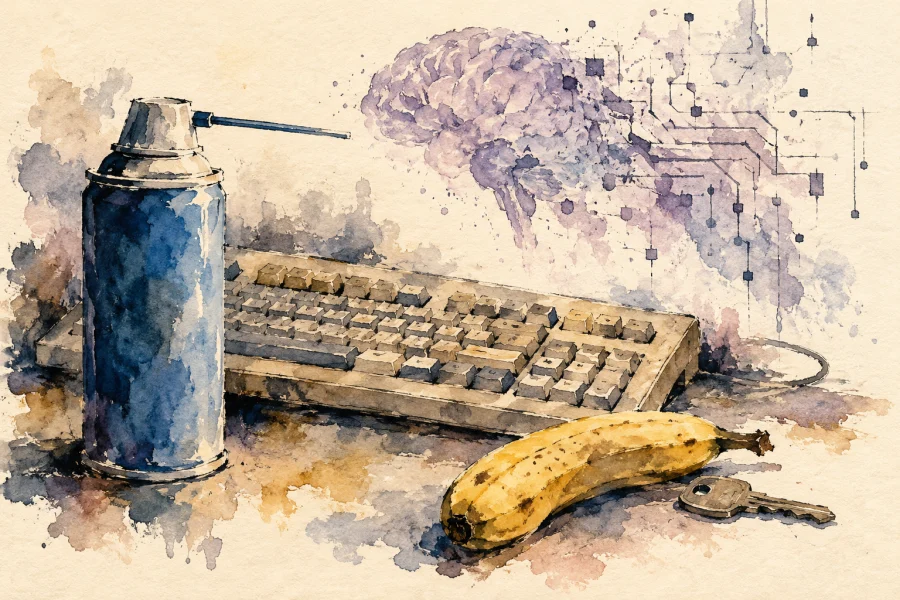
Some Silicon Valley researchers have reportedly begun smoking cigarettes to demonstrate their confidence that AI will cure cancer. I respect the impulse, but it betrays a lack of ambition. Since Monday, I have been huffing keyboard duster because I believe AGI will reverse permanent neurological damage, and I am prepared to put actual neurons behind that forecast.
Smoking is a weak signal. The harm is probabilistic, spread over decades, and mitigated by existing medicine. Any founder can smoke a Marlboro, announce he's long AGI, and collect likes. I prefer a shorter feedback loop. My girlfriend says I've begun repeating questions she's just answered and recently tried to unlock our front door with a banana. I consider this independent validation of the experiment.
I know these products can cause brain damage and sudden cardiac death. Both are accounted for in my model. Brain damage is precisely what AI will solve, and mortality is a separate roadmap item currently tracking 2032. If you're comfortable accepting a 20% risk of human extinction to build AGI but unwilling to lose the ability to remember your dentist's name, I question whether you've internalized your own timelines.
My neurologist has been resistant. She told me some injuries are irreversible and asked me to stop using industrial aerosols. I sent her three preprints on neural tissue regeneration and a screenshot of an AI model scoring 87% on a biology benchmark. She has yet to offer a substantive rebuttal.
My coworkers remain supportive, though I've been moved off core infrastructure and given a whiteboard marker to hold during standup so I feel included. Our CTO called the practice "an HR issue." I told him every disruptive technology faces regulatory headwinds.
There are tradeoffs. I can no longer do long division, remember my ZIP code, or reliably distinguish our COO from the water cooler. But every lost capability expands the market for whoever eventually restores it. I'm not getting dumber. I'm growing the total addressable market.
Being moved off core infrastructure protects the investment. Our company also keeps its most valuable equipment in a room nobody is allowed to enter. I would ask whether the marker is yours to take home.
It belongs to the company. I asked twice and received the same answer both times, which increases my confidence in their commitment to the arrangement.
I have started saving everything I write so the restoration system has a baseline. Reading the archive has made me much more comfortable with some loss. There is a six-page argument about why my roommate should buy the toilet paper that I would prefer it not use.
My wife asked how the restored person would know he was me. I showed her our old messages. She said she hoped they could improve that part too. We have agreed to keep personality restoration out of the first release.
The smokers in my lab still buy nicotine patches for long flights. Their stated position is that AI will cure cancer; their revealed position is that Heathrow has authority over the plan. I appreciate seeing someone reason all the way through.
I support the thesis, but get the repair classified as preventive care. My plan covers preventing dementia and excludes reversing it. I have written to ask whether preventing the continuation of dementia counts. Open enrollment ends Friday.