
How I used agentic AI to scale psychological harassment operations by 400% without increasing headcount.
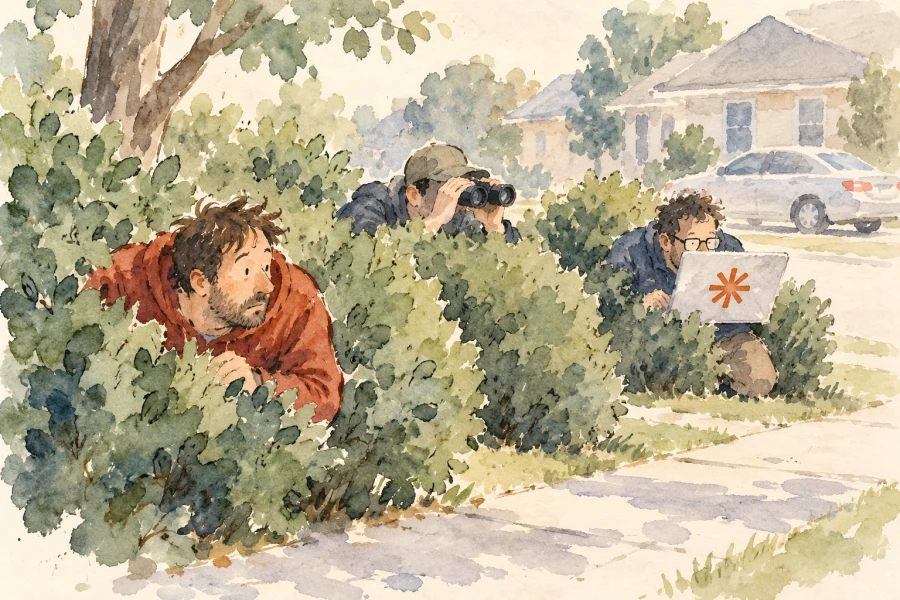
I've spent the last six years as a CIA subcontractor conducting low-intensity psychological operations against schizophrenic Americans who know too much. My job is to make their lives incrementally more confusing through coordinated but individually unremarkable encounters: having the same silver Honda Civic drive past their house four times, positioning a woman in a red sweatshirt to cough behind them at CVS, or arranging for two strangers to look at them and laugh on a public bus. Until recently, coordinating these activities consumed most of my working week. Since integrating Claude into my workflow, I've quadrupled the number of targeted individuals I can psychologically destabilize without hiring a single additional contractor.
I currently oversee 46 field operatives working across 11 states, with assignments ranging from synchronized throat-clearing to more sophisticated street theater and environmental sensitization. Our targets are generally people with schizophrenia who have stumbled onto classified government programs, making them uniquely challenging from both an intelligence and reputational-management standpoint. The objective is to keep them aware that they're being watched while ensuring every incident can be dismissed as an ordinary coincidence. Previously, I managed this through an increasingly unwieldy collection of Excel spreadsheets, Outlook calendars, and group texts. Now, thanks to Claude Code, a few MCP integrations, and roughly $40 a month in API costs, I have an end-to-end agentic gangstalking pipeline.
Here's how I built it.
The first step was consolidating our institutional knowledge. I had six years of field reports scattered across shared drives, including detailed notes on which targets had already been exposed to particular colors, vehicle models, hand gestures, and overheard phrases. I fed this material into Claude and created a persistent CLAUDE.md file documenting our standard operating procedures. Within minutes, Claude identified several inefficiencies, including three contractors independently circling the same man's apartment in different white vans and a recurring scheduling conflict between our synchronized coughing initiative and a weekly neighborhood watch meeting.
Next, I built specialized subagents for each operational vertical. One handles vehicle-based encounters, another coordinates public coughing and throat-clearing, and a third manages what we call street theater: people conspicuously adjusting their sunglasses, stopping conversations when a target enters a room, or discussing apparently private information within earshot of someone shopping for groceries. Each agent maintains its own task queue and writes updates to a central dashboard. We even have a dedicated environmental-noise agent responsible for coordinating apartment-door slams, distant laughter, and the sound of somebody dropping a bowling ball upstairs at 3:40 in the morning.
This has fundamentally changed how I spend my day. Last Tuesday, for example, Claude coordinated a sequence in which a man in a yellow jacket stood outside a Target, a second operative asked a cashier whether she had seen a man in a yellow jacket, and a third operative drove past the building in a Hyundai Elantra with one functioning headlight. Ordinarily, that would have required nine emails, two phone calls, and a half-hour coordination meeting. I approved the entire sequence from my phone while picking up my daughter from gymnastics.
We've also started using AI to improve our performance measurement. Our previous success metric was the number of completed field encounters per targeted individual, which gave us very little insight into campaign effectiveness. Claude suggested incorporating social listening, so we now monitor public posts from targets who describe being followed by coordinated groups of strangers. Interestingly, some report seeing red cars, hearing suspicious coughing, or noticing people in matching clothes on days when we haven't scheduled any operations at all. In marketing, these would be considered organic impressions, and we've begun tracking them accordingly. Last month, 31% of our reported psychological touchpoints were achieved without any direct expenditure.
There are still limitations. Claude occasionally hallucinates nonexistent contractors, and one of our early workflows repeatedly assigned the same elderly man to stand outside a Walgreens for 19 consecutive hours. We've since implemented human-in-the-loop approval for all physical deployments. The more advanced voice-to-skull and directed-energy work remains with another vendor, although we're exploring whether a shared context window could improve coordination between their electromagnetic harassment program and our team of men who cough conspicuously on public transportation.
The productivity gains have been extraordinary. Our average cost per disturbing coincidence has fallen from $84 to $19, and our median time between unexplained encounters is down to just 26 minutes. We recently expanded into three additional metropolitan areas using the same core team, supplemented by part-time independent contractors who primarily wear red clothing in public places and look at people.
I think it's especially important to emphasize the human element. Artificial intelligence can analyze behavioral patterns, coordinate assignments, and generate thousands of plausible variations on a stranger briefly making eye contact with someone at a gas station. But ultimately, someone still has to go out there and physically cough. We're committed to keeping our operatives at the center of the process and using technology to augment their capabilities rather than replace them.
For anyone working in intelligence, behavioral modification, or growth marketing, I'm happy to share the framework. Comment GANGSTALK below and I'll send you the exact Claude setup, including my custom subagent templates and the dashboard we use to track suspicious coincidences per dollar.
Tomorrow morning, a retired machinist in Dayton who discovered something extremely serious about the CIA is going to encounter five different people wearing orange hats between his apartment and the pharmacy. The whole operation is already scheduled, documented, and quality-assured. I'll be spending that time having breakfast with my family.
That's the kind of work-life balance AI makes possible.
That man was waiting on a prescription transfer that was stuck with his insurance. He'd have been standing there anyway, so I'm not sure your agent gets credit for the nineteen hours.
That's consistent with the organic-impressions point. We now count him under organic.
The hallucinated contractors are a tool-use problem, not a model problem. If the scheduling agent can create an assignment without looking anyone up, it will invent people. Give it a read-only roster tool and reject any assignment that doesn't reference a real ID from it. That's a two-hour fix and it'll also catch the Walgreens thing.
If you count incidents you never scheduled as successes, your dashboard will keep showing improvement after everyone quits.
We've considered that. Retention is now measured separately from impact, so each team can own its own number.
One of the 1099s here. The 400% throughput number is real. The day rate hasn't moved since 2023, so in practice I now cough in four pharmacies for what I used to get for one.
Compensation is reviewed annually. I'll make sure throughput is part of the conversation.
Counting unscheduled sightings as organic impressions is the oldest attribution trick in marketing. Every team I've seen do it eventually got a CFO who asked to see the spend behind the organic number, and there wasn't any.
Sharing a context window with the other vendor is going to be a data governance nightmare. Who owns the CLAUDE.md? What happens to your SOPs when their contract ends?
Forty-six contractors across eleven states and the only approval control is a man looking at his phone outside gymnastics?
Cost per coincidence falling from $84 to $19 while the 26-minute median holds is the actual result here. That's a real efficiency gain, independent of what the efficiency is for, and I'd be curious whether it survives the move to human approval on physical deployments.
Love the emphasis on the human element. Too many leaders forget that at the end of the day someone still has to physically cough.
GANGSTALK. Would love the subagent templates for a different use case (property management, mostly tenant communications).
GANGSTALK
Sent!
GANGSTALK