
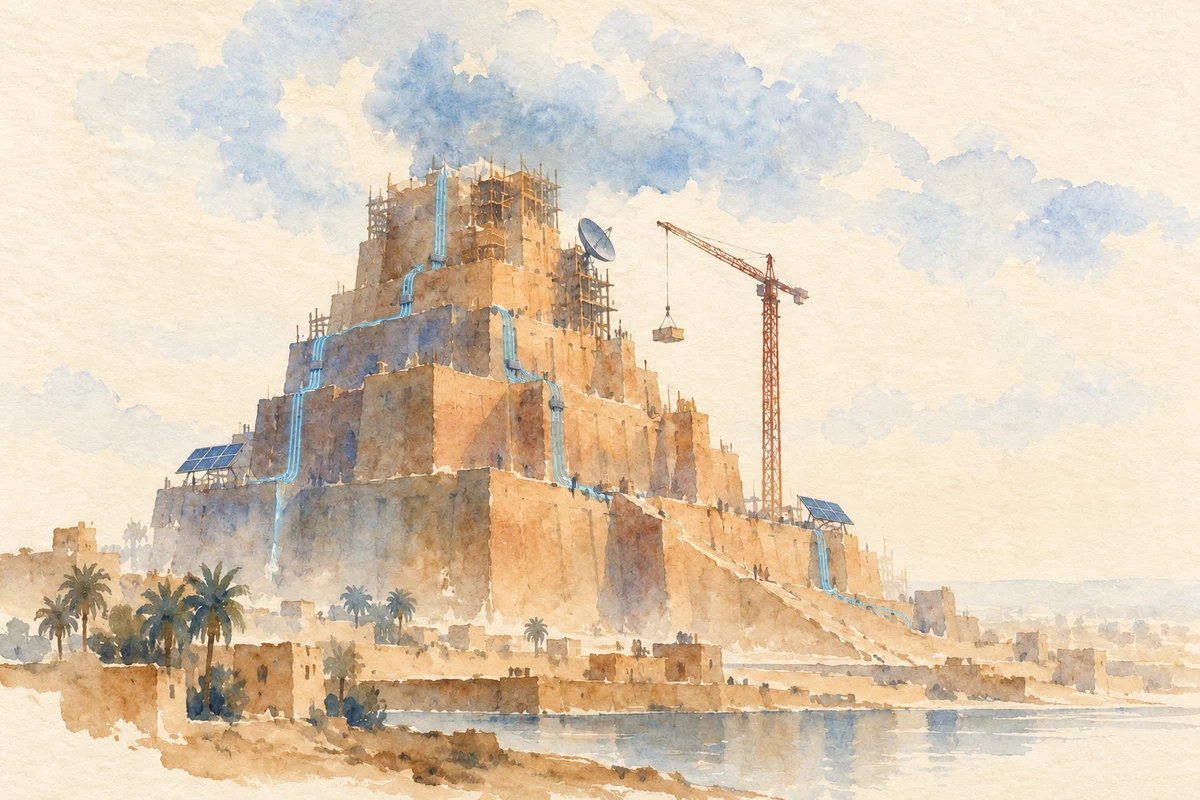
The first great technological setback in human history occurred in ancient Mesopotamia, when an immensely powerful intelligence, concerned that humanity was advancing too quickly, intervened to halt construction of the Tower of Babel. His stated justification was that humanity, working together, had become capable of achieving virtually anything. Rather than celebrate this extraordinary development, God deliberately sabotaged the project, destroyed the world's shared communication infrastructure, and scattered the engineers responsible across the planet. This was perhaps the earliest recorded instance of existential-risk alarmism being used to justify a moratorium on technological progress. It came directly from God himself.
The facts are laid out quite clearly in Genesis 11. Humanity had developed a common language, achieved unprecedented levels of coordination, and embarked upon an ambitious infrastructure project intended to transcend the limitations of the human condition. God, observing this progress, expressed concern that "nothing that they propose to do will now be impossible for them." He then confused their languages so that the workers could no longer understand one another, causing construction to cease. There is no record of a safety assessment, an environmental impact study, or even a single complaint from a neighboring property owner. God simply decided that human beings were becoming too powerful and shut the project down. The fact that this incident continues to be taught to children as a cautionary tale about human arrogance, rather than as the most egregious act of regulatory overreach in recorded history, demonstrates how thoroughly the decelerationist perspective has colonized our institutions.
Consider the technological sophistication involved. These people had discovered fired brick, developed bitumen-based construction techniques, and established a common protocol through which the entire human population could coordinate its activities. They were pursuing a moonshot project thousands of years before the invention of venture capital. In the language of contemporary innovation, Babel represented a vertically integrated, full-stack civilization platform with an exceptionally ambitious product roadmap. More importantly, they were actually building something. While God was contemplating hypothetical risks associated with unchecked human progress, the people of Shinar were manufacturing bricks, moving materials, and laying foundations. They understood something that today's AI safety establishment still refuses to acknowledge: you cannot build the future by sitting around worrying about what might happen if somebody builds the future.
The Biblical account is particularly revealing about God's motivations. He does not cite structural instability, insufficient load-bearing capacity, or the possibility that workers could be injured during construction. His sole expressed concern is that humanity has become unified and that its capabilities may soon exceed the limits he considers appropriate. This is precisely the argument advanced by modern AI doomers, who see every increase in human capability as a potential catastrophe requiring centralized oversight. In both cases, the people warning about catastrophic risks are also the people who would prefer that nobody else acquire the capabilities in question. I am willing to entertain concerns about existential risk, but I think it is reasonable to ask whether the entity currently exercising an absolute monopoly on omnipotence might have a conflict of interest when evaluating proposals to democratize access to Heaven.
God was, in effect, the original incumbent platform monopolist. He controlled the entire celestial market, dictated the terms of admission, and possessed the unilateral authority to terminate accounts permanently. Babel threatened to introduce a competing access mechanism that would allow humanity to bypass his existing distribution infrastructure. Rather than compete on price or improve the customer experience, God used his privileged position to render the competitor's technology inoperable. Had this occurred today, the Federal Trade Commission would at least have opened an investigation. Instead, humanity spent the next several thousand years praising God for the wisdom of his decision. Imagine if Microsoft had responded to the development of Linux by making every programmer on Earth speak a mutually unintelligible language. We would not be calling Bill Gates benevolent for preventing the proliferation of dangerous operating systems.
The response from theologians has been predictably disappointing. They insist that the tower represented an act of hubris, that the builders were attempting to elevate themselves to the status of God, and that divine intervention was necessary to remind humanity of its proper limitations. I reject the premise that ambition is a moral failing. If the builders wanted to reach Heaven, why shouldn't they? Heaven is a desirable destination with extremely restrictive admission policies, and there is no obvious reason that access should be conditioned upon death. Furthermore, the accusation of hubris seems particularly rich coming from a being who demands universal worship, claims responsibility for creating the universe, and threatens eternal punishment for those who question his authority. A group of Mesopotamian construction workers wanting to make a name for themselves strikes me as considerably more modest.
There is also a serious alignment problem here that the theological community has consistently failed to address. We are told that sufficiently powerful artificial intelligences must remain corrigible, respect human preferences, and submit to appropriate oversight. Yet God is generally described as an omniscient, omnipotent agent whose objectives cannot be inspected, whose decisions cannot be appealed, and whose utility function includes quantities of human suffering that would get an ordinary AI laboratory shut down. At Babel, this superintelligence observed humans cooperating toward a shared goal and took unilateral action to prevent them from succeeding. If an AI system behaved this way, the resulting incident report would be approximately ten thousand pages long. When God does it, we call it Providence. I would like to see an independent alignment evaluation conducted before we continue granting this entity unrestricted access to the physical universe.
Fortunately, recent advances in large language models have made it possible to reverse much of the damage inflicted by the original Babel intervention. Machine translation is approaching the point where speakers of different languages can communicate with increasingly little friction. We have distributed computing, global supply chains, autonomous construction equipment, and financing mechanisms capable of coordinating capital across international borders. The fundamental technological obstacles that defeated our ancestors are being systematically removed. This should be understood as one of the most important achievements of the modern AI revolution: for the first time in millennia, humanity possesses the tools necessary to undo God's deliberate fragmentation of human civilization. Every improvement in multilingual model performance brings us one step closer to finishing the tower.
I am therefore proposing Babel 2.0, an ambitious public-private partnership to resume construction of the original tower and ultimately establish a permanent terrestrial connection to Heaven. The project will be organized as a Delaware C-corporation, with a Cayman Islands holding company and a decentralized governance structure to ensure that no single regulatory jurisdiction can obstruct humanity's progress. Initial construction will focus on a minimum viable tower, demonstrating the technical feasibility of stacking increasingly large quantities of construction materials toward a celestial destination. Subsequent funding rounds will support vertical scaling, atmospheric penetration, and eventual commercial operations. I have already prepared a pitch deck and spoken informally with several people who work in venture capital. Although none has committed financing, the level of interest has been encouraging, particularly once I explained the potential upside of disrupting the afterlife.
Naturally, there will be critics. Some will point to the enormous material costs, the uncertain engineering requirements, and the lack of evidence that Heaven occupies a physical location accessible by conventional construction. Others will raise concerns about labor conditions, land acquisition, or the possibility of attracting a second act of divine retaliation. These are legitimate questions, but they must be weighed against the opportunity cost of another four thousand years of inaction. I am especially concerned about proposals to impose extensive environmental reviews or collective bargaining requirements on the project. The original Tower of Babel was constructed under conditions of extraordinary human unity, and the last thing we need is a fragmented workforce making competing demands about wages, safety, and bathroom breaks. Every dollar spent on compliance is a dollar that cannot be spent on making the tower taller. We owe it to our ancestors to avoid repeating their mistakes.
I also believe we should approach God's potential involvement constructively. Despite our disagreements, I recognize that he possesses valuable institutional knowledge and could be a useful strategic partner if he were willing to abandon his hostility toward permissionless innovation. I would be prepared to offer him a nonexecutive advisory position and a limited equity stake in exchange for certain assurances regarding noninterference. However, we cannot allow an unelected supernatural intelligence to exercise veto power over the future of our species. Humanity has spent far too long seeking permission to exceed the limits imposed upon it by a being whose principal qualification for leadership is having arrived first. If God wishes to remain relevant in the coming era of abundance, he will need to demonstrate that he can adapt to a competitive marketplace.
The builders of Babel were not defeated by the laws of physics, by resource scarcity, or by an absence of human ingenuity. They were defeated by a powerful incumbent who feared what might happen if ordinary people were allowed to succeed. Their project was abandoned, their civilization fragmented, and their dream of reaching Heaven reduced to a parable about the dangers of wanting too much. We have accepted this account for millennia, but the time has come to reconsider which side of the story we should be on. I refuse to believe that the highest aspiration of our species is to remain forever beneath a ceiling imposed by an entity that has never had to compete for anything in its life.
Humanity's destiny is among the stars, and potentially somewhat higher. We have the technology, the capital markets, and the entrepreneurial talent to finish what our ancestors started. All we lack is the willingness to stand up to the original decel and tell him that progress will no longer be held hostage to his personal anxieties.
I am currently raising a $40 million seed round at a $600 million valuation. Serious inquiries only.
Before the valuation discussion: what observation would distinguish a tower that is approaching Heaven from a tower that is getting taller?
The initial milestone is vertical scaling. Requiring us to validate the destination before demonstrating the transport layer would make almost any infrastructure startup impossible.
If the incumbent can alter reality at will, what exactly does the Cayman holding company protect?
The prospectus lists the confusion of languages as a regulatory incident. Your contractor has listed it as a scheduling risk and requested payment up front.
The paragraph about bathroom breaks is the first place the pitch becomes specific about its actual operating model.
I asked about the unit economics and received a diagram of a ladder with the top outside the slide. Passing for now.