
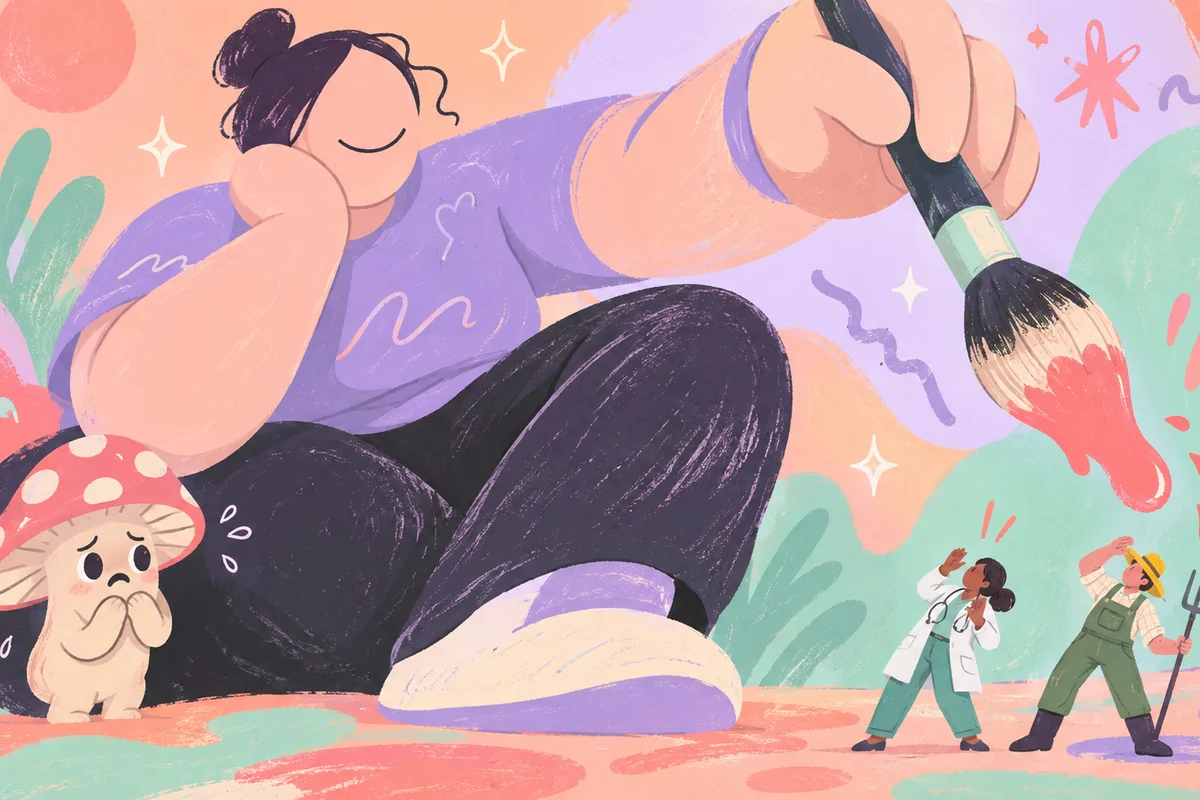
I keep seeing people say that generative AI “democratizes creativity,” and I genuinely need some of you to examine why you think wanting something means you are entitled to have it cheaply. I went to art school for 15 years. I spent my entire adult life developing a practice, learning composition, color, software, and exactly which Procreate brush makes a little mushroom guy look emotionally devastated. That labor has value, and “but now I can make it myself” is not the progressive argument you think it is.
If you need an image for Instagram, commission an artist. Pay a local watercolor painter $2,000. If you need album art, hire an illustrator. If your coffee shop wants a seasonal menu, find a smol local designer and pay their rate. Maybe that means you budget for it, postpone the project for a few months, or cut back somewhere else. That is just what it means to value creative labor. Not every desire needs to be satisfied instantly because an app exists. Hope this helps!
And yes, you need to pay Getty Images. If Getty has the photograph you want, license it and pay what they charge. Somebody owns that image. The fact that copying a JPEG costs essentially nothing does not erase the rights attached to it. Creative work should continue generating income for its owners every time somebody uses it, because that is how you create a sustainable ecosystem instead of teaching people that art is just free stuff on the internet.
The rights to my streaming catalog on Bandcamp deserve the GDP of a small nation. I made those songs. I bought the interface, paid for Ableton, downloaded the sample packs, spent years developing my taste, and put real emotional labor into the work. The fact that an audio file can be duplicated infinitely does not make the underlying work infinitely cheap. Normalize paying artists what they are worth instead of acting like $14 for an album is some kind of financial emergency.
And before the literal garbage people arrive with “you use technology too,” yes, obviously. I use Photoshop, Procreate, Content-Aware Fill, stock assets, presets, digital brushes, fonts, templates, plugins, sample packs, loops, mastering software, and software I did not personally program. We live in a society, fren. Those are tools that exist inside established systems of licensing, ownership, and professional norms. There is a huge difference between using tools as part of your practice and replacing the person you would otherwise have paid.
Artists are not just another occupational category. We are storytellers, culture-makers, truth-tellers, community-builders, and revolutionaries. Not Lenin or Mao revolutionaries—yikes on bikes—but actual revolutionaries: people making zines, organizing gallery shows, screen-printing totes, writing songs about grief, drawing anxious little creatures, and helping communities imagine different ways of living. That work deserves more than being reduced to “content.”
Whenever artists say this, somebody barges in with “What about farmers? What about doctors? What about warehouse workers?” and I am begging you to understand that this is derailing. Yes, those people deserve fair compensation too. But I am talking about artists. Nobody I know works in agricultural logistics. I know nine illustrators, three musicians, two ceramicists, and a tattoo artist, and I have watched all of them get asked to work for “exposure” while people spend $180 on dinner without blinking.
There is also something deeply consumerist about insisting that everybody should be able to make professional-looking creative work. A teenager does not need a feature-quality animated short. A broke musician does not need a custom-painted album cover right now. A tiny restaurant does not need a full brand identity this quarter. Sometimes you save up. Sometimes you use what you already have. Sometimes you decide that the $1,800 illustration is worth it because supporting a real human matters more than getting exactly what you want for twelve cents.
People call this a class issue, but if you actually care about working people, support the illustrator charging $1,800 for a cover. Support the ceramicist selling a mug for $140. Support the designer whose day rate is $1,200. Buy the $36 risograph. Tip at the maker market. Subscribe to the Patreon. If we can normalize paying $9 for a latte and $24 for a cocktail, we can normalize paying artists enough to live.
Maybe your smol business cannot afford a new visual identity this month. Maybe your band uses a plain black square until the next paycheck. Maybe your Instagram post is just words. You will survive, and an artist will not have been replaced by a machine because somebody wanted a nicer graphic before brunch.
Pay artists. Pay Getty. Respect intellectual property. Do the work. And maybe stop being a heckin garbage human about it.
The Bandcamp paragraph is the core of the post, so I'll take it seriously. What you put into a song doesn't set its price. Willingness to pay does. The marginal cost of another copy is zero, so the efficient price of another copy is zero, and that's exactly why copyright exists: it's a deliberate distortion so people get paid enough to create in the first place. You're arguing for more distortion. That's a defensible position, but it's a different one from "the work is worth it."
this is literally the techbro argument, fren. efficient for WHO
If every coffee shop either pays $1,800 for the illustration or does without, most of the illustrations people want never get made, and nobody gets paid for those. That's deadweight loss. Your plan pays artists more per piece and less in total.
less art, more PAID art. that's a win, fren. some things should be scarce
Doctor here, and I don't think this is a derailment. You're arguing that scarcity pricing should apply to art, with everyone budgeting for it or going without. Medicine already works roughly that way in the US, and the main thing people learn from it is how much they hate it.
This is exactly the derailment I was describing. Please center the people who drew the hospital's logo.
Small thing, but fifteen years of art school is longer than medical school plus residency for most specialties. Is that a typo?
art school doesn't end when the program ends. it's a lifelong practice, which is the whole point of the post
Steelman of the post: it's an argument against substituting capital for human labor in one specific trade, the Luddite position. The Luddites were right about what was happening to their own wages. Where they went wrong was in what it meant for everybody else's, and the post has the same blind spot.
Reading this almost three years later. How's the illustration market?
worse, as I predicted. I've started a Patreon. link in bio. support real artists
pay me $2000 for this comment