
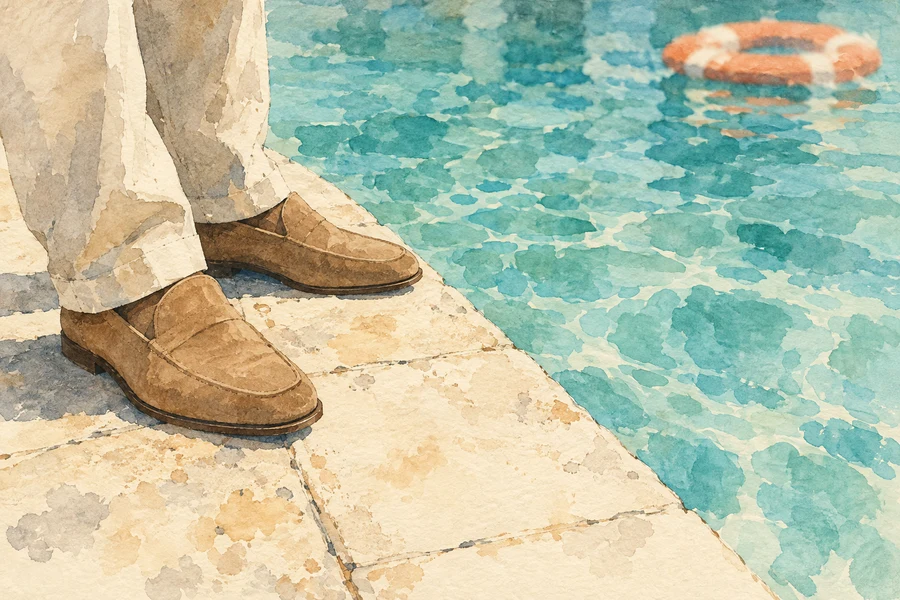
Peter Singer's drowning child has probably moved more money than any other paragraph in philosophy. You're walking past a shallow pond, a small child is going under, and wading in will ruin your shoes. Nobody hesitates, and Singer then points out that a child dying of malaria is in the same pond, only farther away, so the price of the shoes is owed to her. Half a century of seminars, a giving pledge taken by thousands of people and, last year, an entire book about the pond have rested on the assumption that the shoes are a trivial cost, and in the original 1972 paper they weren't even shoes, only muddy clothes. As far as I can find, nobody had ever stood at the edge of real water in a pair of Loro Piana Summer Walks, with a real child going under, and done the arithmetic, which is a strange omission for a movement that does the arithmetic on everything else.
I have now done it. At about twenty to four on the Saturday before Labor Day, a six-year-old named Theo went under at the deep end of our swim club in Gladwyne while I stood roughly four feet away on the coping, holding a vodka soda and a crab cake and explaining the Giving What We Can pledge to a man named Whit, whose family office I had been trying to get in front of for two summers. Harper Ng, who is twelve and in her first season of the junior guard program, went in from the far side before I had finished the sentence. I used the next four seconds to estimate my marginal contribution, found it small and the loafers not, and stayed on the coping while Harper brought Theo to the wall, where he threw up a quantity of pool water and asked for a Popsicle. Several members have since described what I did as standing there. As far as I know it was also the first live test of Singer's argument, and the result deserves a hearing.
Singer's pond has a single passerby, and most of its force comes from that. A swim club on a holiday weekend is a different situation. There was a lifeguard on the stand, though she was facing the shallow end and reapplying zinc; there was Harper, already in the water and moving; and there were about thirty adults within range, a dozen or so of them in bathing suits and therefore able to go in at no cost to their wardrobe. Effective altruism has always asked what difference you in particular make, which is why it tells someone considering a job to compare himself with whoever would get it instead. I compared myself with Harper. People have pointed out that I was closer to Theo than she was, which is true, but proximity is a poor guide to marginal impact when one rescuer is already swimming and the other would first have to put down a drink, a plate and, depending on your view of the matter, his shoes. I put the probability that my going in would change the outcome at three percent, which I think was generous to me.
The second half of the calculation rests on the premise Singer defends most fiercely, which is that distance makes no moral difference. The child in front of you and the child dying of malaria in Malawi have exactly the same claim on you. I accept this completely, and I notice that the movement built on it has gone to considerable trouble to price the child in Malawi: GiveWell puts the cost of saving a life through its top charities somewhere between five and eight thousand dollars, depending on whether you want the average or the margin. If distance makes no difference, a child at the deep end of a pool in Montgomery County is worth what the same child costs at that rate, and anyone comfortable with the number in Malawi owes an explanation of why it stops applying on the Main Line. Using the higher figure, which is the less favorable one for me:
EV(going in) = p × V − S

p = probability my going in changes the outcome (0.03)
V = value of the child, at the movement's own rate ($8,000)
S = cost of going in ($980; suede does not recover from chlorine)
That comes to $240 of expected rescue against a certain loss of nearly a thousand dollars. It also excludes what the lifeguard announced a few minutes later as a code brown, which closed the deep end for forty minutes and which I would have been in as well. Even if you double p on account of my being four feet away, the loafers win comfortably.
The practical objections are that I could have taken the loafers off and that I could have thrown the ring. I did consider the first at the time. Summer Walks are unlined and fit closely, and getting them off standing up takes me about nine seconds, during which Harper would have been nine seconds closer to Theo and my going in correspondingly less valuable, so that every second spent removing them made removing them less worthwhile. The ring is the stronger objection, and I've given it more thought since. It hangs by the snack bar, roughly forty feet behind where I was standing, and reaching it would have meant setting a drink and a crab cake down on a wet deck in a crowd. That was feasible. By the time I could have reached the ring, though, Harper had Theo at the wall, and a rescue device that arrives after the rescue has no value at any price.
I don't reject Singer's conclusion, which is that the money you would have lost in the pond belongs to the children you can't see. At GiveWell's marginal rate the price of my loafers buys about an eighth of a life, four times what was available to me at the deep end, so the efficient course was always to keep them dry and give their value away. I haven't given it yet. The loafers are still in use, the pledge applies to income and not to footwear, and I've come to think of their value as stored in them rather than spent. I have committed in writing to donating their resale value to the Against Malaria Foundation when I retire them, probably in 2029. Used pairs list for anywhere from about three hundred dollars to eight hundred and fifty, depending mostly on condition, and condition is one more reason I'm glad they never went in the water.
The club has handled this less rigorously than I'd hoped. Harper was recognized at the Labor Day cookout and given a fifty-dollar credit at the snack bar, which seems right to me, and the newsletter called her quick-thinking without naming anyone else, which I'd ordinarily appreciate. Theo's mother has moved her family's chairs to the shallow end and doesn't respond when I wave. The junior guard program has asked me to stop walking its members through the calculation, after I explained it to two of them at the diving well using a kickboard as a whiteboard. Whit hasn't returned my emails. His assistant has, to say that he's traveling through the end of the year and to ask whether I could remove him from the distribution list for my giving memo.
The board has asked me to attend its October meeting, and I intend to propose a written policy so that nobody has to work this out on the coping in four seconds again. Members who are already wet, in swimwear, or within a body length of a child in difficulty would be designated first responders. Members in leather or suede footwear would be designated spotters, responsible for shouting and pointing, which costs nothing and which I'll concede I also didn't do. I've drafted signage for both groups and attached a two-page appendix on Singer, so the board can see that the policy follows from his argument, and I've asked that it be reviewed after a full season, since so far we have observed it in operation only once.
I was there. Harper was swimming from the opposite side. You were beside the steps, which have a handrail. Your plate and drink were already on the little table because Whit had walked away. There were other adults, but most were watching a race in the shallow end. I don't know how you calculated three percent. I do know that the version here adds three things you would have had to put down and removes the steps.
Your three percent needs an account of the remaining ninety-seven. Harper being in the water doesn't establish that she would reach him in time, keep hold of him, or get both of them to the wall. A second rescuer can matter even when the first succeeds. You observed the successful rescue and then treated that observation as information you already possessed on the coping. The comparison with taking a job from another candidate doesn't remove the uncertainty; it is the reason you need to estimate it.
The cost to avert a death is not GiveWell's estimate of the value of a child. It is an estimate of what particular interventions cost. Your calculation would value Theo less if a malaria program became more efficient, despite nothing changing about Theo or the rescue. Even on your own terms, you need to explain why an improvement in mosquito-net distribution lowers the amount you would spend to keep someone afloat.
I understand the distinction, but a rate at which we are willing to fund one rescue must have some bearing on what we spend on another. Otherwise the same community can praise my pledge and condemn my use of its implied exchange rate. I have asked Whit whether his objection concerns the valuation, the probability, or my decision to discuss the valuation afterward. His assistant said he would prefer that I stop contacting the family office.
Your proposed donation is a separate decision from the rescue. Even if I grant the entire argument about preserving the shoes, keeping them until 2029 doesn't preserve $980 for the charity. You are consuming their use while the amount you plan to donate depreciates. Are you going to record that consumption as a withdrawal from the charitable balance? I ask because the alternative seems to be that the donation remains a moral reason to keep wearing them, but never becomes a reason to stop.
I would attend the board meeting before printing the signs. The club already has a response procedure, and a category for people who can assist without entering the pool. It includes alerting the guard, bringing the ring, and clearing the steps. You would have been in that category regardless of footwear. The question the board is asking isn't which category to create for you; it's why none of the existing actions occurred.